Ignacio at a small organopónico (urban farm) in Cienfuegos
Raised beds of mostly lettuce.
Sorghum
is planted at the ends of vegetable beds to keep bugs away. When the
Soviet Union collapsed in 1989, Cuba lost its biggest trading partner
and also its source of cheap, subsidized oil. Cuba plummeted into a
time of economic crisis and food shortages referred to as the "Special
Period." Imported products like agricultural fertilizers were no longer
affordable. Since oil became prohibitively expensive for Cubans, the
nation is considered to have reached "Peak Oil" in the early 1990's.
The Soviet Union's collapse forced Cuba to find solutions to their food
and gas shortages across the island. Once Cuba lacked the resources
for chemical-intensive farming, the entire country quickly converted to
nearly 100% organic agricultural production. In a few years, market
vegetable gardens were constructed within cities in closer proximity to
the country's population eliminating the impossible costs required for
transport and refrigeration. These small urban farms are called organopónicos. As
the rest of the international community faces the prospect of reaching
"Peak Oil" in the future, many farmers and environmentalists are looking
at Cuba today to see how they endured during the Special Period and how
they created one of the highest concentrations of urban organic farms
in the world.

Señor Colina, the jefe of this garden, and one of his workers

Almost
all farms I visited used marigolds at the ends of their beds as an
organic insect repellent. The photos above and below are from Vivero
Alamar outside Havana. This farm has received international funding,
employed over a hundred farmers and utilized some advanced organic
farming techniques, like devices attached to the irrigation hoses to
magnetize the water. Although I had watched a video documentary of this
farm before coming to Cuba in which a Mexican volunteer explained that
it was enjoyable and easy to pop in and lend a hand, the folks at Vivero
Alamar seemed fearful to allow me to spend time onsite with just a
tourist visa. They seem to fear repercussions from the government for
hosting tourists while not being sanctioned to do so. They did ask me
if I was a terrorist (though half-joking, I think) and told me I could
spend more days there if I obtained a work visa, (which sounded nearly
impossible with the necessary time, money and signatures required.)


On
one of the few channels available on Cuban television, they sometimes
show educational farming programs. They discussed pertinent organic
techniques like intercropping, crop rotation, when to plant seeds, etc.
for the casual home gardener or professional farmers.
Bananas at a larger organopónico in Cienfuegos
Friendly farmers in Cienfuegos...
The
plant above is a type of oregano. Oregano was also frequently used as
an organic insect repellent on the borders of vegetable beds all around
Cuba.
Fields of tobacco in Viñales
Baby pineapple
This
garden was interesting. It's a garden of the local MinInt office.
MinInt is short for Ministerio del Interior, (Interior Ministry), which
is basically like Cuba's federal police. This would be like local
branches of the FBI having their own personal organic vegetable gardens!
One evening I strolled by and a guy who was harvesting told me that it
was fine to come in take a photo, but it was getting dark. The next
afternoon, I walked by and tried to enter the garden again but a
different man sternly told me that I could not enter nor even walk
alongside one side of the fence because the garden belonged to the
police.
These
farmers were transplanting tomato plants. While some farmers around
Cuba were welcoming, some, like these, were quite suspicious of me and
my intentions. These in particular asked me to leave before I
"contaminated" their beds with my non-farm clothes.
This
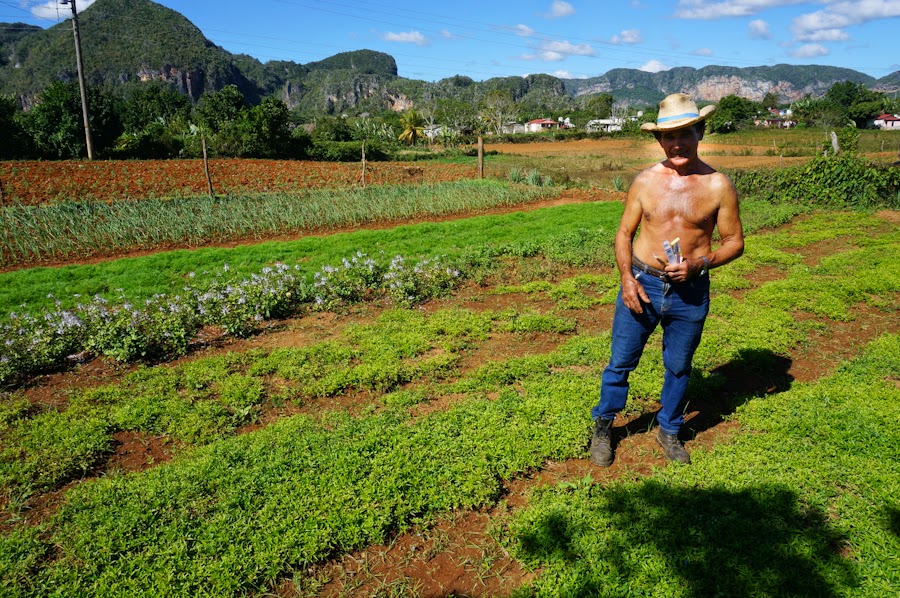
gentleman cultivates a farm of medicinal plants in Viñales. He was
quite friendly and introduced plants to me that I was not familiar with.
Farmer
at an organopónico in Trinidad. Just outside the city center, there
were three small farms all next to each other along the road.
Irrigating lettuce
Another farmer in Trinidad
Carrots
Lotsa lettuce